From Chatbots to Predictive Analytics: How AI Is Transforming Marketing Automation
Artificial intelligence has moved far beyond being a buzzword in marketing circles. What started as simple rule-based automation — auto-responders, basic email triggers, and static drip campaigns — has evolved into a sophisticated ecosystem of intelligent systems that can predict customer behavior, personalize experiences in real time, and make decisions faster than any human team could manage. Today, AI touches nearly every stage of the marketing funnel, from the first chatbot conversation a visitor has on your website to the predictive model that decides which customers are most likely to churn next month.
In this article, we'll explore how AI has transformed marketing automation, the key technologies driving this shift, and what it means for businesses trying to stay competitive in an increasingly data-driven landscape.
The Early Days: Rule-Based Automation
Before AI entered the picture, marketing automation was largely rule-based. Marketers set up "if-this-then-that" workflows: if a user opened an email, send a follow-up three days later; if a lead filled out a form, assign them to a sales rep. These systems were useful for saving time, but they lacked intelligence. They couldn't adapt to individual behavior, couldn't learn from outcomes, and treated every customer segment the same way regardless of how they actually engaged.
This rigidity created a gap — marketers had automation, but not personalization at scale. That gap is exactly what AI has been closing over the past several years.
Chatbots: The First Wave of AI-Driven Engagement
Chatbots were one of the earliest and most visible applications of AI in marketing. Early chatbots were simple, using decision trees to guide users through predefined conversation paths. But as natural language processing (NLP) matured, chatbots became capable of understanding intent, context, and even sentiment.
Modern AI chatbots can now:
Answer complex customer questions without human intervention
Qualify leads by asking dynamic, context-aware questions
Recommend products based on browsing behavior and stated preferences
Hand off seamlessly to human agents when a conversation requires it
Operate 24/7 across websites, social media, and messaging apps
For marketing teams, this means fewer dropped leads, faster response times, and a more consistent customer experience — all without scaling headcount. Chatbots also generate valuable behavioral data that feeds into other AI systems, creating a feedback loop that improves targeting and messaging over time.
Personalization at Scale
One of AI's biggest contributions to ai marketing automation is its ability to personalize content, offers, and messaging for individual users rather than broad segments. Traditional segmentation might group customers by age or location. AI-driven personalization goes much deeper, analyzing browsing history, purchase patterns, email engagement, and even time-of-day activity to tailor experiences uniquely to each person.
This shows up in practical ways such as:
Dynamic website content that changes based on visitor behavior
Product recommendations that update in real time
Email subject lines and send times optimized per recipient
Ad creative that adapts based on what has previously resonated with a user
The result is marketing that feels less like a broadcast and more like a conversation — which is a major driver of improved conversion rates and customer loyalty.
Predictive Analytics: Marketing That Looks Ahead
Perhaps the most powerful shift AI has brought to marketing automation is predictive analytics. Rather than reacting to what customers have already done, predictive models forecast what they're likely to do next.
Predictive analytics tools use historical and real-time data to:
Score leads based on their likelihood to convert, helping sales teams prioritize outreach
Predict churn by identifying behavioral patterns that precede a customer canceling or disengaging
Forecast lifetime value, allowing marketers to invest more in high-value customer segments
Optimize campaign timing, sending messages when a specific user is statistically most likely to engage
Anticipate demand, helping align marketing pushes with inventory and sales cycles
This shift from reactive to predictive marketing allows businesses to intervene before problems occur — reaching out to an at-risk customer before they churn, or nudging a warm lead before a competitor does.
How These Technologies Work Together
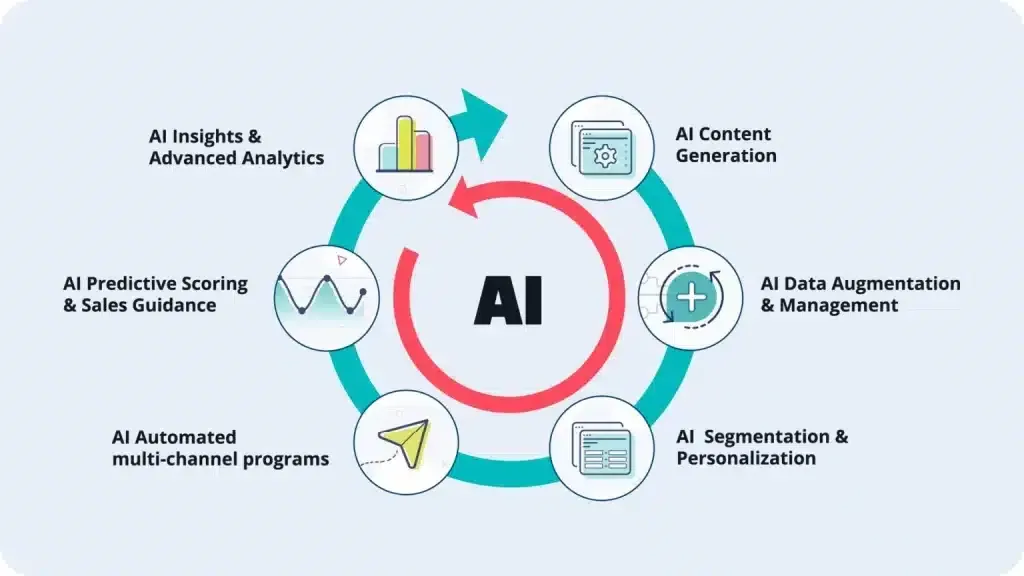
Chatbots, personalization engines, and predictive analytics aren't isolated tools — they form an interconnected system. A chatbot conversation generates data that feeds a predictive model. That model informs which content a personalization engine serves next. The results of that content's performance then refine the predictive model further.
This creates a continuous learning loop: the more a system is used, the smarter and more accurate it becomes. For marketing teams, this means automation isn't just about efficiency anymore — it's about building a self-improving engine that gets better at understanding and serving customers over time.
What This Means for Marketers Going Forward
The transformation from simple automation to AI-driven marketing has real implications for how teams should operate:
Data quality matters more than ever. AI systems are only as good as the data feeding them, making clean, unified customer data a competitive advantage.
Marketers need new skills. Understanding how to interpret AI-generated insights and work alongside these tools is becoming as important as traditional campaign management skills.
Smaller businesses can compete with larger ones. AI tools have lowered the barrier to entry for sophisticated marketing, letting lean teams execute strategies that once required large budgets and dedicated data science teams.
The human element still matters. AI handles scale and prediction well, but strategy, brand voice, and emotional resonance still require human judgment.
Final Thoughts
AI has fundamentally changed what marketing automation can do — shifting it from a tool for saving time to a strategic engine for understanding and anticipating customer behavior. From chatbots that engage visitors instantly to predictive models that forecast what customers will do next, AI is no longer a "nice to have" in marketing; it's becoming the foundation on which effective, scalable marketing strategy is built.
Businesses that embrace this shift — investing in good data, the right tools, and the skills to interpret AI-driven insights — will be far better positioned to build lasting customer relationships and stay ahead of the competition in the years ahead.
